Secondhand and Thirdhand Smoke: The Real Harm to Your Family and Children
Secondhand and Thirdhand Smoke: The Real Harm to Your Family and Children
When someone in the home smokes, the three most common consolations are: "I'll smoke on the balcony," "The window is open," and "The smoke has cleared, the kids can't smell it." For adults, this looks like a polite compromise; for children, what's reduced in the air is the "visible smoke ring," but not necessarily the harmful exposure.
Secondhand smoke is the environmental tobacco smoke that is being produced and inhaled in real time; thirdhand smoke is the residue that remains on clothes, sofas, curtains, car seats, and toy surfaces after the cigarette is out, plus the products formed when these residues continue to react with indoor air. This article is for readers with families—especially those with children—to explain clearly the effects of passive smoking on children's nasal cavity, airways, and cognition-related risks, and the persistence of thirdhand smoke residue, and to provide family protection actions you can actually carry out. Serious, but not alarmist; it covers the risks and what you can do right now to protect your family.
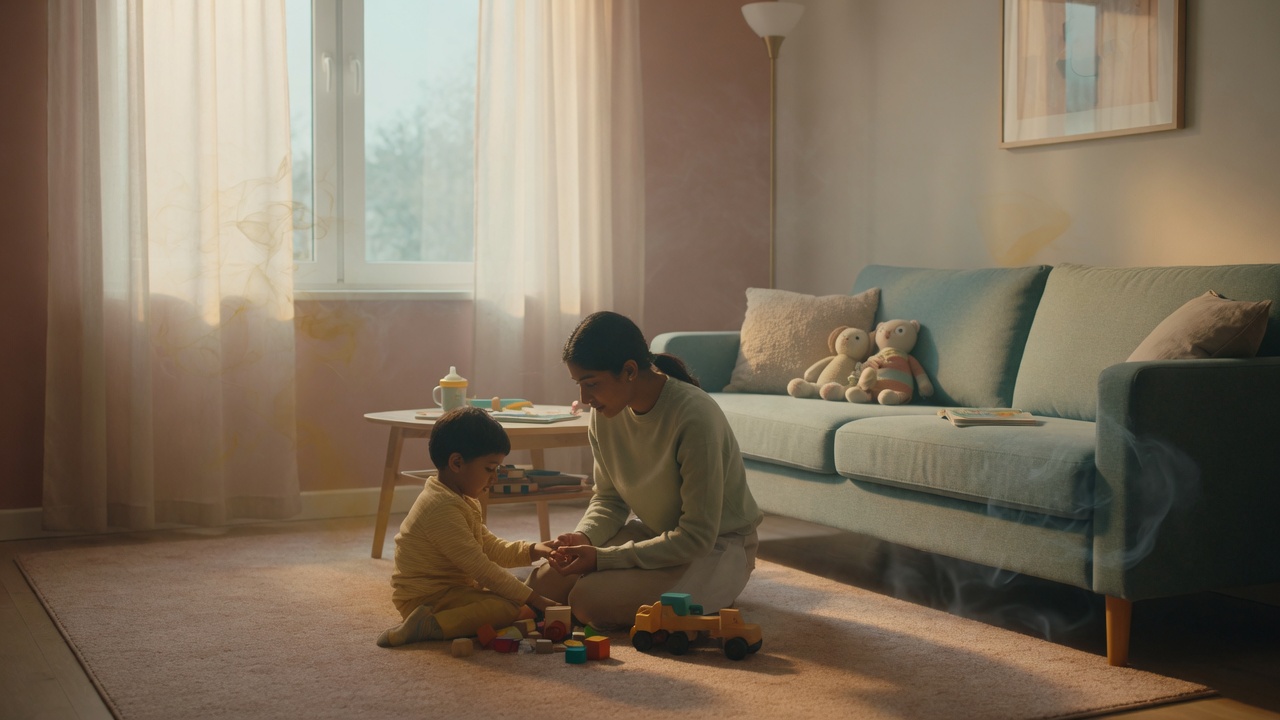
I. Secondhand and Thirdhand Smoke: The Smoke Clears, but the Risk May Not
Let's first separate two concepts that are easily conflated.
Secondhand smoke (often called environmental tobacco smoke) comes mainly from two sources: the sidestream smoke released while a cigarette smolders, and the remnants of mainstream smoke exhaled by the smoker. It contains nicotine, carbon monoxide, fine particulate matter, plus a large number of irritating, oxidative, and cancer-risk-related compounds. The component profile overlaps heavily with active smoking—the difference is often that the child has no choice, yet shares the same air.
Thirdhand smoke refers to the residue that remains adsorbed on surfaces and in dust after tobacco smoke dissipates: nicotine and related alkaloids, the precursors and products of tobacco-specific nitrosamines, polycyclic aromatic hydrocarbons, and more. They can cling to walls, carpets, sofa covers, car headliners, plush toys, and be slowly re-released over the following hours, days, or even longer; in indoor environments with ozone, nitrogen oxides, and the like, secondary chemical reactions may also occur, generating new harmful substances.
In short: "Not seeing smoke" does not mean "no tobacco-related exposure." What a family truly needs to manage is not only the few minutes a cigarette is lit, but also the air and surfaces after the cigarette is out.
II. Why Children Are Less Able to "Take It" Than Adults
Sitting in the same living room, children often bear a disproportionate dose burden. The reasons aren't mysterious, but are frequently ignored.
1. Higher ventilation-to-weight ratio
Children's ventilation per unit of body weight is higher; at the same air concentration, the inhaled amount adjusted for body weight tends to be higher.
2. Activity height is closer to the ground
Infants and toddlers crawl and play on floors, carpets, and sofa edges—exactly the height where dust and residue are more likely to settle. Thirdhand-smoke-related particles and semi-volatile substances often accumulate at these interfaces.
3. More active hand-to-mouth pathway
Sucking fingers, chewing toys, touching furniture and then rubbing eyes and nose are normal behaviors in developmental stages, and they make it easier for surface residue to enter the body through the mouth and nose.
4. Barriers and immunity are still developing
Nasal mucociliary clearance, immune response, the blood-brain barrier, and nervous-system connections are all in the fortifying process. Chronic irritation during sensitive windows affects not just "current comfort," but may also perturb developmental trajectories.
5. They cannot vote with their feet
Adults can leave a room or end a gathering; toddlers cannot. The essence of household exposure is often a cumulative, low-dose, long-term, day-after-day accumulation.
Therefore, using an adult's subjective feeling ("It smells fine to me") to infer a child's safety margin is unreliable.
III. The Nose Sounds the Alarm First: Passive Smoking and Children's Nasal Cavity
The nose is the outpost of the respiratory tract. Particulate matter and irritating gases in the smoke hit the nasal mucosa first.
1. Mucosa and cilia: the clearing system is slowed down
A healthy nasal mucosa relies on ciliary beating and the mucus blanket to transport dust, pathogens, and particles outward. Oxidants and toxic components in tobacco smoke interfere with this process: ciliary activity drops, mucus properties change, and the local microenvironment becomes more favorable for lingering inflammation. The result is not "occasional discomfort," but more like an overlap of diminished clearing capacity plus persistent irritation.
2. Common nasal symptoms in the home
In long-term secondhand-smoke or obvious thirdhand-smoke environments, children are more likely to develop or worsen:
- Chronic or recurrent nasal congestion, runny nose, nasal itching;
- "Always seems to have a cold" yet no single infection focus can be found;
- Mouth breathing at night, a tendency to snore, fragmented sleep;
- Heightened or dulled sense of smell (manifesting as picky eating, abnormal responses to odor stimuli, and other non-specific signals).
These symptoms can overlap with allergic rhinitis, adenoid hypertrophy, and dry-season irritation. The insidious thing about the smoke factor is that it rarely signs its name, yet often adds to the burden behind the scenes.
3. The pathway leading up to the middle ear
Nasopharyngeal inflammation and eustachian-tube dysfunction are important backgrounds for middle-ear effusion and recurrent otitis media in children. The link between passive smoking and children's middle-ear problems is repeatedly discussed in pediatric and public-health literature. You don't have to blame every earache on smoke, but if there's long-term smoking at home and you keep agonizing over "is it cross-infection at kindergarten," you may miss an environmental factor you can actually change.
4. Easily obscured attribution
"It's the season change," "The air conditioning is too dry," "Allergy to dust mites"—these could all be true. Smoke exposure is not mutually exclusive with them. A more realistic understanding is: allergic constitution + smoke irritation + dryness/infection will push the nasal mucosa into a state that's harder to recover from. Removing the indoor tobacco source first is the lowest-cost, cleanest-logic step.
IV. Extending Downward: Respiratory Infections, Asthma, and Lung Development
The nose is only the entrance. Smoke particles and gases continue downward, affecting the larynx, trachea, bronchi, and alveoli.
1. Infections and inflammation land more easily
The risk of lower-respiratory-tract infections in children (such as bronchitis, pneumonia, etc.) is shown to be higher under household secondhand-smoke exposure in multiple observational studies. The mechanistic framework includes: weakened mucosal barriers, disordered local immune regulation, and reduced ciliary clearance, making it easier for pathogens to gain a foothold and inflammation to amplify.
2. Asthma and wheezing: triggering and worsening
For children who already have a tendency to wheeze or have asthma, smoke is a clear worsening factor: more frequent attacks, more severe symptoms, and tougher drug control. For children not yet diagnosed with asthma, long-term exposure may also raise the probability of recurrent wheezing. Household smoking control is not "optional," but an environmental pillar of asthma management alongside avoiding allergens and following prescribed medication.
3. Lung-function development trajectory
Childhood is an important stage for airway and alveolar development. Continuous tobacco-smoke exposure may adversely affect the long-term trajectory of lung-function indicators—this effect may not show alarming numbers on today's checkup report, but may leave traces on exercise tolerance or airway hyperresponsiveness in adolescence or adulthood. Public-health statements usually adopt directional risk rather than promising "X cigarettes = Y milliliters lost." For parents, the sufficient message is: avoidable chronic exposure is not worth gambling on with "seems fine for now."
4. A special note on infants (restrained statement)
The risk factors for Sudden Infant Death Syndrome (SIDS) are multifactorial, and family and public-health guidelines generally list avoiding smoking during pregnancy and postpartum secondhand-smoke exposure as important protective measures. This section does not dramatize extreme scenarios; it only emphasizes that an infant's bedroom and sleep environment should strive to be smoke-free and free of severe residual contamination.
V. Invisible Effects: Cognition- and Behavior-Related Signals
Respiratory symptoms are visible; changes in cognition and behavior are often attributed to "personality," "screen time," or "school pressure."
1. Why the nervous system is discussed
Nicotine is a neuroactive substance, and the developing brain is more sensitive to perturbations of the cholinergic system. Secondhand-smoke exposure means children may continue to take in low levels of nicotine and its metabolites (such as cotinine, detectable in body fluids). In addition, carbon monoxide affects oxygen supply, and fine particulate matter and systemic low-grade inflammation may also affect the brain's microenvironment through indirect pathways. These constitute a mechanistically reasonable concern, not an already-written verdict.
2. What the research suggests
Observational studies and some experimental-psychology work suggest that long-term environmental tobacco-smoke exposure may be associated with attention problems, deviations in learning and memory performance, and elevated risk of certain behavioral problems. For example, studies comparing frequently-exposed vs. less-exposed non-smokers have found group differences on tasks such as prospective memory. It must be emphasized:
- Most evidence is observational, with complex confounders (family socioeconomic status, parenting style, other pollutants, etc.);
- Correlation does not equal simple causation;
- But it does not mean it can be ignored—especially when exposure can be actively cut off by the family.
3. Non-specific signals the family may notice
The following cannot be used for self-diagnosis, and serve only as part of an "environmental checklist":
- Greater difficulty sustaining attention in class or while doing homework;
- Emotional irritability, poor sleep quality, with consequent unstable daytime state;
- Memory and executive-task performance ("forgetting what was just said") falling short of age-appropriate expectations.
The priority remains: improve sleep, maintain a regular routine, reduce smoke exposure, and seek pediatric or professional assessment when needed—rather than labeling the child.
VI. How "Stubborn" Is Thirdhand Smoke: Residue, Re-release, and Secondary Reactions
Thirdhand smoke deserves its own chapter because it exposes the "half-measures" most common in household smoking control.
1. Adsorption and re-release
Semi-volatile substances like nicotine are good at burrowing into fabric fibers, foam fillers, and dust. When people walk by, temperatures rise, or humidity changes, they can re-enter the breathing zone. So a familiar phenomenon occurs: the room no longer "smells of the acrid smoke just produced," yet a stale smoke-stale feeling lingers—especially in car interiors and curtains from long-term smoking.
2. Secondary chemical reactions
Residues are not immutable. They can react with oxidants in indoor air, generating secondary pollutants including tobacco-specific nitrosamines. This means: thirdhand smoke is not just "old smoke smell," but potentially a slow chemical process.
3. Why the dose is larger for children
| Scenario | Adult | Child |
|---|---|---|
| Contact height | Mostly seated/standing breathing zone | Crawling, lying down, close to deposition surfaces |
| Hand-to-mouth contact | Relatively little | Frequent entry of toys and fingers into mouth |
| Metabolism and detoxification | Relatively mature | Still developing |
| Ability to leave | Can leave on their own | Depends on caregiver's decision |
Some studies and popular-science materials note that, under the same environmental conditions, the relative harm of thirdhand smoke to children can be significantly higher than to adults (the order-of-magnitude statement varies by study design, and this article does not fix it as a single-fold myth). A sounder conclusion is: the same sofa is not the same exposure for a crawling toddler and a standing adult.
4. Debunking a few "seemingly reasonable" practices
- Only smoking on the balcony: Smoke can still flow back in; clothes and hair have already adsorbed residue, becoming a mobile pollution source once back inside.
- Opening the window for ten minutes: Helps dilute secondhand-smoke plumes, but does little for thirdhand smoke that has already penetrated fabrics and dust.
- Holding the child only after smoking: Reduces "blowing smoke in their face," but may deliver clothing residue straight to the infant's breathing zone and skin.
- Just changing the outer layer: Helps, but does not equal complete decontamination; hair, skin, finger gaps, and indoor surfaces remain.
VII. A Family-Actionable Smoke-Free and Residue-Removal Checklist
The goal is not moral perfection, but bringing down the child's cumulative dose.
1. The rules layer (most effective)
- Completely smoke-free indoors: Living room, bedroom, bathroom, kitchen—no exceptions.
- Smoke-free car: A confined space has high concentrations and strong interior adsorption, making it a thirdhand-smoke disaster zone.
- Don't "demonstrate smoking" in front of children: Reduce imitation and normalization.
- If someone smokes outdoors: Wash hands and face on returning, change clothes and rinse the mouth if possible, before close contact with an infant.
2. The cleaning layer (targeting thirdhand smoke)
- Washable fabrics: Curtains, sofa covers, bedding, pillow covers, car seat covers—deep-wash regularly according to material.
- Hard surfaces: Desks, windowsills, floors, and door handles wiped with an appropriate cleaning method (choose by surface material; avoid misusing corrosive chemicals that could harm children).
- Plush toys and crawling mats: Include them in the washing plan, rather than "looks not dirty, keep using it."
- Rooms smoked in for years: Air fresheners only mask, they don't remove; you need cleaning + ventilation + replacing severely adsorbed fabrics when necessary.
- Air purifiers (if used): Choose filtration effective against particles, and realistically know that it assists air quality but cannot replace "not lighting up indoors."
3. Socializing and visiting
- Before visiting relatives and friends, find out whether they smoke indoors; choose outdoor meetings or shorten time spent in smoky rooms where possible.
- In public places, stay away from smoking points and the smoke plume at elevator entrances.
- When picking up from daycare or after-school classes, watch for secondhand-smoke gathering spots among the pickup crowd.
4. Adult smoking cessation and support (in principle)
A parent quitting smoking is the most thorough investment in household air quality. When intense withdrawal or repeated relapse occurs, adults can seek a formal smoking-cessation clinic or, under a doctor's guidance, evaluate intervention options. No nicotine-containing product should ever be given to children.
5. When to see a doctor (not a substitute for diagnosis and treatment)
Situations warranting timely contact with a pediatrician or ENT include but are not limited to:
- Recurrent wheezing, rapid breathing, or obvious impact on feeding or activity;
- Frequent otitis media or suspected hearing decline;
- Severe nasal congestion affecting sleep and growth-related indicators;
- Persistent parental concerns about attention or developmental milestones.
Difficulty breathing, blue lips, altered consciousness, severe stridor, or high fever with poor spirits should prompt emergency care.
VIII. Conclusion: Write Protection into the House Rules, Not into Guilt
Secondhand smoke harms those currently sharing the air; thirdhand smoke harms those who still live in this house "after the cigarette is out." For children, the nose usually sounds the alarm first, the airway pays the bill next, and cognition- and behavior-related risks are more hidden, requiring long-term environmental improvement to counterbalance.
If you're a smoking parent: this is not to convict you, but to return the choice to you—you can decide whether the air at home continues to be tinted with tobacco residue.
If you're a non-smoking caregiver: your persistence is not "being overly sensitive," but is fighting for a measurably lower exposure for the child.
The day the family smoke-free rule is written into the house rules is more useful than the day it's written into an anxious social-media post. The smoke clears, and the risk can clear with it—provided we acknowledge that the residue is real and are willing to clean it up.
Quick Summary of This Article
- Secondhand smoke is the environmental tobacco smoke being inhaled; thirdhand smoke is the residue that remains adsorbed on surfaces after the cigarette is out and can be re-released or even undergo secondary reactions.
- Children are often more sensitive to the same exposure due to ventilation-to-weight ratio, ground-level activity, hand-to-mouth pathway, and developing barriers.
- Passive smoking can irritate the nasal mucosa and cilia, worsening congestion, runny nose, recurrent upper-respiratory discomfort, and is directionally associated with middle-ear problems.
- Lower-respiratory infections, asthma triggering/worsening, and lung-function development trajectories are the core concerns at the airway level.
- Cognition- and attention-related effects are mostly suggested by observational evidence and should not be absolutized, but are enough to support a family decision of "avoid when you can."
- Opening windows, smoking on the balcony, and holding the child only after smoking cannot fully solve thirdhand smoke; it requires smoke-free rules plus surface and fabric cleaning.
- Cars and long-term smoking rooms are residue disaster zones; air fresheners cannot replace removal.
- Protecting children relies on actionable house rules and judgment on when to seek medical care—not on shame, and not on luck.